

Rebuilding Agriculture After Floods: A Practical Guide for Farmers of Upper Assam
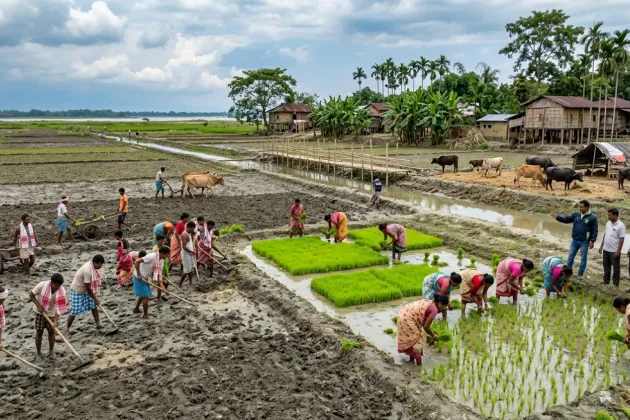

The recurring floods in Upper Assam—especially across Charaideo, Sivasagar, Jorhat and Golaghat—highlight the delicate balance between agriculture and nature. While floods have long been part of Assam's landscape, their growing intensity and frequency have made recovery increasingly difficult. Crops are destroyed, fertile soil is eroded, and farmers face severe livelihood challenges.
Yet agriculture must endure. With timely action, scientific approaches and adaptive strategies, farmers can revive their fields and rebuild resilience. The following guide presents practical, field-level measures to support post-flood agricultural recovery.
1. First Steps After Floodwaters Recede
The immediate priority is to restore fields for cultivation.
- Drain out stagnant water using natural channels or pumps.
- Remove excess sand or silt deposits.
- Clear debris such as plant residues, plastics and dead organic matter.
- Allow the soil to dry moderately before beginning field operations.
A quick soil assessment is essential, as floods may either enrich fields with nutrient-rich silt or reduce fertility through excessive sand deposition.
2. Restoring Soil Health
Floods often disrupt soil fertility and biological balance. Restoration measures include:
- Applying organic matter such as farmyard manure (FYM), compost or green manure.
- Using biofertilisers such as Azotobacter and phosphate-solubilising bacteria (PSB).
- Applying lime where soils are acidic.
- Deep ploughing to improve aeration and root development.
Soil testing is strongly recommended to determine nutrient deficiencies and guide fertiliser application.
3. Crop Planning for Recovery
Short-duration paddy varieties
Farmers can opt for short-duration rice varieties such as:
- Luit
- Disang
- Kolong
- IR-64 (where suitable)
These varieties mature within 90 to 110 days and can help recover part of the season's production.
Alternative crops
Where paddy cultivation is no longer feasible, farmers may consider:
- Pulses: Black gram (urd), green gram (moong)
- Oilseeds: Mustard, sesame
- Vegetables: Cowpea, okra, cucumber, pumpkin and radish
- Fodder crops: Maize, sorghum and Napier grass
4. Nursery Raising and Replanting
- Raise community nurseries in elevated areas.
- Use dapog or mat nursery techniques.
- Transplant seedlings when fields become workable.
- Maintain proper spacing to encourage healthy growth.
5. Balanced Nutrient Management
- Apply nitrogen in split doses.
- Use phosphorus and potassium to strengthen root systems.
- Combine organic and inorganic fertilisers for long-term soil health.
6. Pest and Disease Management
Flood-affected fields are vulnerable to pest attacks and disease outbreaks.
- Monitor fields regularly.
- Use biological control methods wherever possible.
- Apply pesticides judiciously and only on expert advice.
- Remove infected plants promptly to prevent further spread.
7. Integrating Livestock and Fisheries
Flood recovery should also include livestock and fisheries.
- Ensure vaccination and proper healthcare for livestock.
- Provide clean drinking water and dry fodder.
- Repair damaged ponds, disinfect water and restock with suitable fish species.
An integrated farming system can diversify income and reduce future risks.
8. Improving Water Management
Long-term resilience depends on effective water management.
- Develop proper drainage systems.
- Construct raised bunds to reduce future flood damage.
- Adopt rainwater harvesting techniques.
Community-level planning is essential for sustainable water management.
9. Leveraging Government Support
Farmers should make full use of available government schemes, including:
- Crop insurance under the Pradhan Mantri Fasal Bima Yojana (PMFBY)
- Input subsidies and relief packages
- Seed distribution programmes
- Technical assistance from the Agriculture Department and allied agencies
Timely reporting of crop losses and proper documentation can help farmers access these benefits.
10. Moving Towards Climate-Resilient Farming
Farmers should gradually adopt practices that improve resilience, including:
- Flood-tolerant crop varieties
- Crop diversification
- System of Rice Intensification (SRI), where suitable
- Organic and natural farming practices
- Community seed banks for indigenous varieties
11. Strengthening Community Cooperation
Recovery becomes easier when communities work together.
- Form farmer groups and cooperatives.
- Share seeds, tools and labour.
- Participate in training programmes and awareness campaigns.
- Collaborate with agricultural institutions and NGOs.
12. Building Mental Resilience
Flood recovery is not only physical but also emotional.
- Remain hopeful and proactive.
- Seek support from the community and local institutions.
- Focus on gradual recovery rather than immediate restoration.
Conclusion
The floods in Upper Assam have caused widespread damage, but they also present an opportunity to rebuild agriculture on stronger foundations. By restoring soil health, adopting adaptive cropping strategies and making effective use of institutional support, farmers can recover while building greater resilience against future disasters.
With determination, scientific planning and collective effort, the fields of Charaideo, Sivasagar, Jorhat and Golaghat can flourish once again. Agriculture in Assam has repeatedly overcome adversity, and with the right support, it can emerge from this crisis stronger and better prepared for the future.
Comments (0)
No comments yet. Be the first to share your thoughts.
Leave a Comment